
Name-Based Case Searches
Indiana runs a statewide public case portal, MyCase / Odyssey Public Access. Parke Circuit Court appears in it. Under the Name tab you can enter a surname, first name, and middle name for a person. A separate business name field exists too. Fill in only what narrows the results. A company goes in the business-name field, never the individual boxes.
Set the Court field to Parke County. When you know the category, add Civil, Criminal & Citation, Family, or Probate. Status and file-date ranges shrink a crowded list fast. Before opening any row, check the county, court, file date, status date, case type, and style. That way the Parke County court docket entry you read is the right one.
- Open MyCase and choose Name.
- Enter a surname and first name, or use the business-name field.
- Select Parke County and the best case category.
- Narrow by open, closed, or filing dates if needed.
- Open only the row whose court, type, dates, and style match the intended case.
Parke Docket Search Filters
The leanest search usually wins. Piling on extra fields can bury a valid result whenever a name was filed with a different spelling. Begin with the known identifier or core name, then layer on Parke County, the category, status, and dates in that order.
| Field | Best Use | Parke Search Note |
|---|---|---|
| Case | Known case number | Use the 61C01 prefix when known |
| Name | Individual party | Begin with surname and first name |
| Business | Entity party | Keep it out of personal-name fields |
| Attorney | Known counsel or bar number | Useful when party spelling is uncertain |
| Category | Limit subject area | Criminal, Civil, Family, or Probate |
A broad Parke County docket search may hit the portal's result cap. Refine the terms rather than chasing a giant list. CAPTCHA and anti-mining rules keep MyCase built for targeted lookup, not bulk extraction.
Case Number Searches
Nothing beats a full Parke case number for a dependable docket lookup. The general format is 61C01-YYMM-TYPE-SEQ. Here "61" marks Parke County, "C01" marks Parke Circuit Court, the next digits give the filing year and month, and the letters name the case group. A sequence number closes it out.
Type the known value on the Case tab. That tab also takes a citation number or cross-reference. If nothing comes back, retry the official number without optional punctuation or leading zeroes, verify the Parke County selection, and recheck each character against the notice. Never guess at a type code.
Indiana Administrative Rule 8 defines the case-code groups. Criminal examples include CF and CM; civil codes include CT, EV, PL, and SC; probate groups include ES, GU, and TR. Codes simply route the case. They say nothing about its outcome, and they promise nothing about public documents.
Recover a Failed Parke Search
A blank result can mean several things. Maybe the court or category is wrong, or the name is spelled differently in the file. An older record may hold converted Odyssey events. The case could also be confidential, sealed, expunged, or blocked from remote display. One failed search proves none of these.
Try this order: Remove extra name fields, verify Parke County, search the case number without optional marks, widen the filing dates, and ask the Parke Clerk to confirm the official record.
The Parke County Clerk holds the local case files and handles copies, certifications, and questions about record availability. Give the clerk the case number, an approximate filing period, the party role, and the case type, and skip any private details the request does not need.
Case Search Results Explained
Think of a Parke result row as an index. Open it and the case summary can show the court, type and subtype, file and status dates, case style, references, parties, charges where they apply, CCS events, documents, and financial data. What actually appears varies with the case and the access rule.
| Header | Case number, court, type, subtype, file date, status, and case style. |
|---|---|
| Parties | Public names and roles, with protected fields omitted or redacted. |
| CCS | Dated filings, hearings, orders, judgments, and other events. |
| Documents | A limited set of public files when remote access is allowed. |
| Financial | Charges, credits, payments, balance, or payment action where enabled. |
A label of active or closed is not a judgment. Read the latest relevant CCS entry and the actual disposition before concluding anything. Financial totals can run incomplete, and the clerk's account is the one that controls.
Parke Case Summary Access Levels
MyCase separates public, party, and attorney access. A member of the public may see the case header and CCS. Not every filed document is included. Parties and their attorneys can hold different authorized access. That gap reflects identity, role, and court rules, not a broken search.
The MyCase access explanation spells out the rules on documents, protection orders, expungement, and financial limits.
The state's own guidance shows why a visible CCS entry does not guarantee a public link to the pleading behind it.
Two Ways to Search: County and State
Parke County offers no separate county-built docket database. MyCase serves as the statewide public portal, and Parke Circuit Court runs on its Odyssey-based record. For the local channel, the Parke Clerk's official file and counter is it; there is no second competing web index.
| MyCase Statewide Search | Parke Clerk Record |
|---|---|
| Free targeted public search | Official local case file |
| Case number, name, attorney, and filters | Case-specific inspection and copy request |
| Public header, CCS, some documents | Available complete or certified material |
| May omit restricted or unlinked files | Applies access rules and redaction locally |
Use MyCase to spot the 61C01 number, the event date, and the document. Turn to the Clerk when you need a copy, a seal, a current balance, or an official answer.
Parke MyCase Use Rules
Indiana's MyCase Terms of Use warns about accuracy and bars data mining. Treat the portal as a public court-information tool, not a replacement for the originating court record. Search one known matter, guard personal details, and verify any fact that affects the case itself.
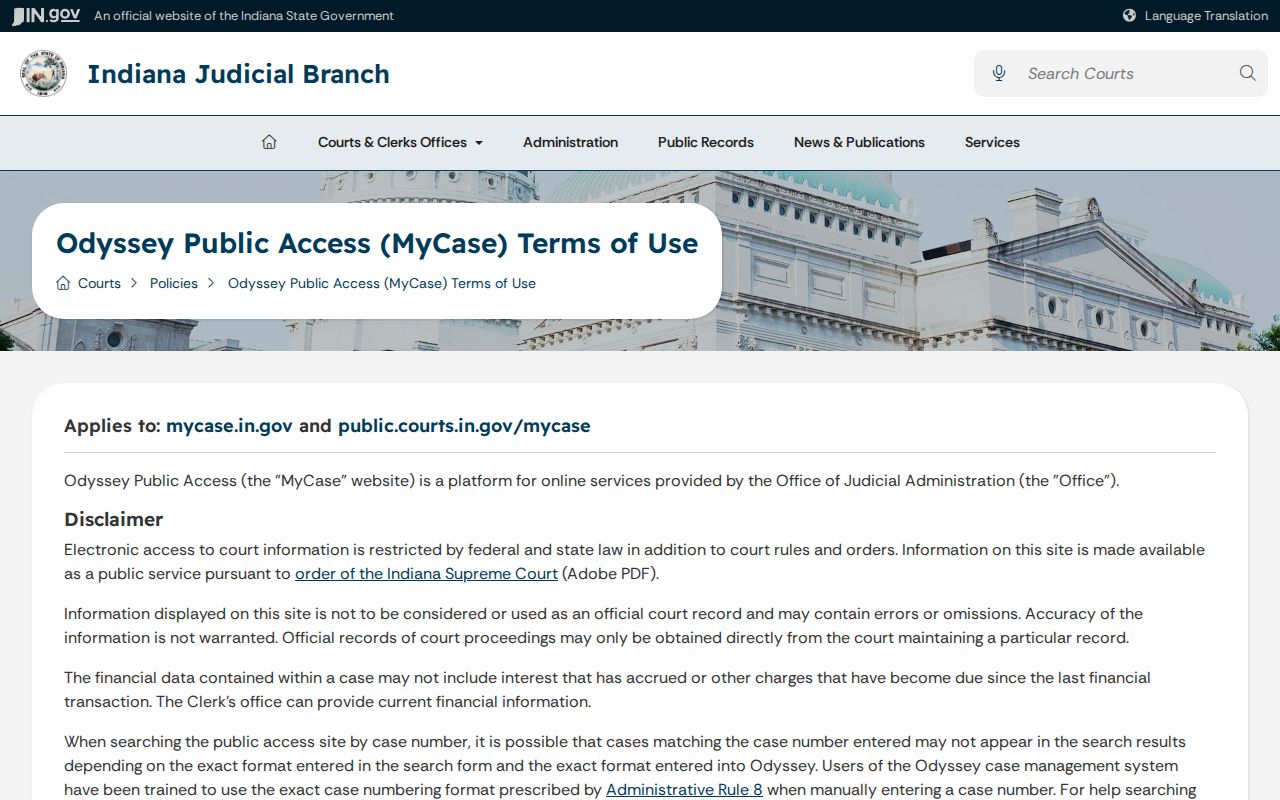
The terms support targeted searching and confirming Parke case facts with the clerk.
Which Cases Stay Restricted
Indiana Rule 5 excludes or limits a long list of material. It covers confidential cases, sealed documents, mental-health matters, some juvenile and old paternity records, adoption, medical information, private identifiers, custody evaluations, victim and witness information, and other protected content. Names in protection orders may not surface through the ordinary public interface. Expungement can also change what the public sees.
Rule 6 builds a verified process for extraordinary restrictions. It requires notice, a legal showing, and the least-restrictive relief. No search term can bypass those rules. Ask the clerk about lawful access instead of reading meaning into an absence.
Verify Parke Docket Search Results
Note the case number first. Then note the exact CCS event you care about before asking anyone for help. Need a copy? Tell the Parke Clerk whether you want an ordinary version or a certified one. Want a transcript instead? That request goes to the court reporter, not the clerk. For a hearing date, check the CCS against the Parke County court schedule routes. Call the court if the two disagree.
Older files and converted events often carry less detail online. A cross-reference can tie records together, but it proves nothing about identity or liability. The official Parke Circuit Court file is still the final word on what happened.
Parke Docket Status Needs Context
Open and closed are just filters. They narrow a Parke County docket search, yet neither one answers the real question. A case marked open may have no hearing anywhere on the calendar. A case marked closed can still collect fee notices, corrections, enforcement, or appellate entries after the fact. The status date, the filing date, and the last CCS event may all differ. Keep that in mind.
So compare before you trust a name match. Check the county, the identifier 61C01, the case type, the filing period, and the case style. Then find the CCS event that actually bears on your question. When the outcome is what you need, read the judgment itself. A closed label tells you nothing about how the case ended.
Attorney Searches for Parke Cases
Sometimes you know the lawyer but not how a party was styled. The Attorney tab handles that. Search by attorney name or bar number. Then pick Parke County and the relevant dates, and the docket returns filings without any guesswork on party names.
Counsel changes over time, though. An attorney hit only shows an appearance, not lasting representation and certainly not a result. Read the appearance and withdrawal entries in the CCS to see where things stand. If a bar number pulls too many rows, tighten the dates and the status. And before you rely on a match, confirm the Parke County case number.
Older Parke Records May Be Converted
Parke records from earlier eras often moved into the modern Odyssey system. A converted CCS event is an old paper entry. Someone carried it into the electronic history. Conversion can leave an index behind while the images stay offline. Pages missing from the portal do not mean the archived record never existed.
For those files, go to the Parke Clerk. Bring the approximate year, the case number, the parties, and the document you want. Ask whether it sits in electronic form, on paper, in storage, under restriction, or inside a historical gap. Parke County's past includes an 1858 courthouse fire, which matters a great deal for very old research. The clerk must confirm an item's status first. Otherwise, say only that it did not appear in the public portal.
Search results can also split related proceedings apart. A related-case field or cross-reference helps you move between records. It cannot prove two names are the same person. Open each summary and weigh its court, dates, roles, and case type. Need one exact older document? Request that document by name. Skip pulling every record tied to a broad surname.